
Enceladus
 At a Glance
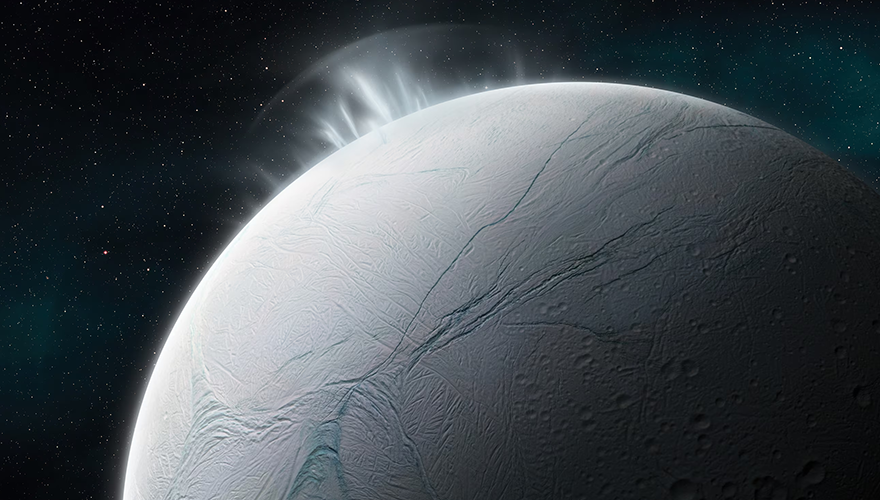
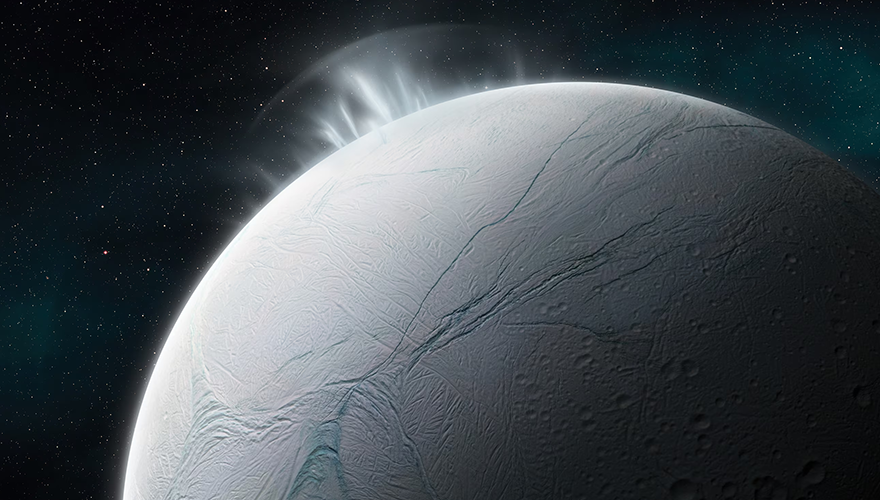
Designated Saturn II by the Federation's official Catalog of Astronomical Bodies, Enceladus is one of the most reflective bodies in the Sol System. It is a small moon- the sixth largest of Saturn's 141 moons- and the 18th largest in Sol. The moon has an equatorial diameter of 513 kilometers. The moon boasts two principle colonies and several unincorporated "bathyscaphe" habitats which are part of the Federation Science Council. All are member polities of the Outer Worlds Commonwealth and are part of the Saturn Bloc.
Enceladus is comprised of an icy-sandy crust under a very tenuous atmosphere of water vapor and a few other volatiles. The glacial crust covers an equatorial and subtropical zone "global ocean" while the northern and southern temperate zones form super-caverns filled with slushy and liquid water trapped inside icy warrens. The polar zones are unstable and have combinations of free water and a thinner ice cover. These areas are cryovolcanic.
Where Enceladus has global oceans, these bodies can be as deep as fifty kilometers. Beneath the ocean zone is a solid core made of silica, carbon and trace amounts of metals.
Early on, along with Europa and Titan, Enceladus confirmed the existence of extra-planetary life independent of evolution on Earth. This confirmation would not take place until after World War III, though circumstantial evidence was discovered by the Cassini probe starting in 2005 CE.